
Duong Anh (Tom) Nguyen
CS student · Robot motion planning · LLM & multi-agent systems · ML from scratch
About
I'm Duong Anh (Tom) Nguyen, a B.S. Computer Science student at San Francisco Bay University (GPA 3.89, graduating Dec 2027). I work on robot motion planning research and on LLM and multi-agent systems that run in production, not just demos.
Research: with Dr. Satarupa Mukherjee I study when goal-biased RRT motion planning fails. So far that is 30,000+ simulated maze trials, and a first-author paper is in preparation.
Engineering: founding member and DevOps AI engineer at Quiche, Inc. (MCP server, multi-agent assistant, GCP), LLM intern at Sofeast Ltd. (RAG, model benchmarking), and IT student staff at SFBU. On the side I build Tomville (a retro terminal view of an AI agent team, on PyPI), TTorch (a C++ autograd engine, on PyPI) and Desir (a voice-first assistant).
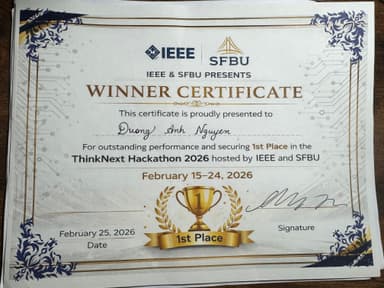
NVIDIA Certified Professional — Agentic AI. 1st place at ThinkNext 2026 (Uniflow) and Top 3 at the SFBU IEEE NVIDIA GTC Hackathon 2025 (BleuLaMuse).
Stay hungry, stay foolish — Steve Jobs
Experience
May 2026 — Present
Researcher, Robot Motion Planning

School of Engineering, SFBU · Advisor: Dr. Satarupa Mukherjee
- Ran 30,000+ simulated trials characterizing failure modes of goal-biased RRT (Rapidly-exploring Random Tree) motion planning across parameterized maze environments, varying one parameter at a time to isolate causal effects.
- Found that a single obstacle blocking the direct start-to-goal path cuts planner success by 68% (77.8% → 24.7%), and that the best step size depends on the environment rather than being a global constant.
- Validated results with multiple independent statistical tests and a held-out 1,000-trial replication; first-author paper in preparation.
Motion planning · RRT · Robotics · Simulation · Statistical testing · Python
Sep 2025 — Present
IT Student Staff
San Francisco Bay University — IT Department
- Delivered Tier-1 diagnostic support for desktops, laptops, classroom AV, printers, Wi-Fi, and software accounts—logging tickets, reproducing issues, and resolving or escalating with clear notes.
- Supported faculty and staff during class hours: quick swaps for faulty gear, password resets, VPN and SSO troubleshooting, and coordination with vendors when hardware needed replacement.
- Maintained a digital inventory of IT assets—serial numbers, deployment locations, warranty status—so refreshes, audits, and maintenance cycles stay accountable.
- Helped track lifecycle events (deploy, retire, repair) so procurement and classroom readiness stay aligned.
IT support · Networking · Hardware · Asset management · Help desk
Nov 2025 — May 2026
Founding Member, DevOps AI Engineer

Quiche, Inc. (ADU Marketplace)
- Cut assistant response time 58% (60s → 25s) by splitting each query across a multi-agent pipeline (Pydantic AI) that routes every subtask to a specialized agent.
- Architected the company's MCP (Model Context Protocol) server so AI features request structured context from internal tools and data stores, with role-based access control and explicit handling when retrieval returns nothing.
- Owned integration work between MCP surfaces and product APIs: tool schemas, auth boundaries, and failure modes.
- Provisioned GCP infrastructure—Compute Engine for workloads that need persistent VMs, Cloud Run for HTTP services, Cloud SQL for relational state—tuning hosting cost and cold-start latency.
- Iterated on chunking, indexing, and evaluation loops as new assistant capabilities shipped.
MCP · Python · Multi-agent AI · GCP · Compute Engine · Cloud Run · Cloud SQL · Pydantic AI · FastAPI
May 2025 — Aug 2025
LLM Research and Implementation Intern

Sofeast Ltd.
- Built a LangChain + FAISS RAG pipeline that answers staff questions over internal documents with citations, cutting repeat questions between coworkers by 20%.
- Benchmarked 5 open-source LLMs (Llama 3, Mistral, Gemma, Qwen, Deepseek) against proprietary APIs on latency, token cost, and answer quality, using the same automated evaluation for each before recommending one for deployment.
- Refined prompt templates and retrieval settings (top-k, filters, stop sequences) to reduce hallucinations, checking every change against a fixed regression set.
- Documented pipeline configuration and failure cases so full-time engineers could extend or debug the stack after the internship.
RAG · LangChain · FAISS · LLM · Python · Llama · Mistral · Prompt engineering
Education
Aug 2024 — Dec 2027
B.S. Computer Science

San Francisco Bay University · Fremont, CA
B.S. in Computer Science (expected Dec 2027). GPA: 3.89. Coursework spans Data Structures, AI, Algorithms, ML, Deep Learning, Multi-Agent Systems, Cloud Computing, Computer Vision, NLP, MCP, and FastAPI—applied in parallel through research, internships, hackathons, and personal builds.
Data Structures · Algorithms · AI · ML · Deep Learning · Multi-Agent Systems · Cloud Computing · Computer Vision · NLP · MCP · FastAPI
Sep 2021 — Jun 2024
High School

Le Hong Phong High School for the Gifted — Nam Dinh Province
Class of 2024 — concentration in Chemistry.
Chemistry
Projects
- Terminal app (Python + Textual) that shows a team of AI coding agents (Claude Code, Codex) as pixel pets in a retro office; each pet's movement reflects that agent's live status read from herdr (working at its desk, blocked and jumping, idle in the lounge).
- Reads the task board from GitHub Issues or a local TASKS.md and animates the handover: the lead assigns a card, workers take it, and it moves through Todo, Doing, Review and Done.
- Supports two team shapes, lead + workers and a planner → coder → tester pipeline, each with its own office layout.
- tmv CLI builds, starts and stops a team (new, up, down) and handles tasks, messages and health checks (task, send, doctor).
- Optional Telegram bot: message the team from a phone, approve agent permission requests with buttons, and get pinged when an agent is blocked or a card is ready for review; no open port, token stored outside the project.
- Published on PyPI (pip install tomville, v0.2.1) with 283 tests and CI on Ubuntu and macOS.
Python · Textual · TUI · Multi-agent · Claude Code · Codex · GitHub Issues · Telegram · PyPI
- Built a real-time, voice-driven assistant on OpenAI Realtime API—streaming speech input with low-latency paths toward tool calls and UI updates.
- Designed an orchestrator that routes user intent to specialist sub-agents (email, calendar, web search, messaging, knowledge base) with explicit handoffs instead of one monolithic prompt.
- Implemented permission-style gates so sensitive actions (send mail, run OS automation) only fire after user confirmation policies.
- Shipped a React/Vite SPA talking to a Python WebSocket backend; orchestration implemented with Pydantic AI for structured outputs and safer tool schemas.
- Integrated third-party APIs—Resend for mail, Serper for search—and macOS automation hooks where local actions are required.
- Added Logfire traces across orchestrator steps to debug multi-turn failures without guessing which agent dropped context.
OpenAI Realtime API · Pydantic AI · React · Vite · Python · WebSocket · Multi-agent · LLM
- Implemented a tensor library and autograd engine in C++ with Python bindings—PyTorch-style tensors, views, and backward passes, written for clarity.
- Built a dynamic computation graph with modular gradient primitives (Add, Multiply, ReLU, Dot) so new ops plug in without rewriting the engine.
- Implemented reverse-mode autodiff with correct topological ordering for multi-use tensors.
- Packaged as pip install ttorch: Python API → pybind11 bindings → C++ core → autograd.
- Automated releases with cibuildwheel and GitHub Actions: 15 wheels for Linux, Windows, and macOS (Apple Silicon and Intel) on Python 3.11–3.13, published to PyPI on tagged releases.
C++ · Python · pybind11 · Autograd · Deep Learning · PyPI
- Two-stage CV pipeline: YOLOv11n finds faces in a webcam stream; a classifier predicts one of seven emotions per face.
- Used a frozen ViT-B/16 as a feature extractor (768-D embeddings), feeding a logistic-regression head written from scratch in PyTorch and trained with L-BFGS.
- Wrote the training and evaluation loop by hand (accuracy, precision, recall, F1, confusion matrices) and validated across 5 stratified 70/15/15 splits.
- Reached 73.5% test accuracy on the Kaggle Facial Expression Dataset, against a 14% chance baseline.
Computer Vision · PyTorch · YOLO · ViT · Real-time
- Interactive React/JavaScript front-end that renders mazes and animates search frontiers as algorithms expand nodes.
- Implemented BFS, flood fill, and a randomized search variant with identical interfaces so students can compare behavior apples-to-apples.
- Supports configurable grid sizes and procedural wall layouts with deterministic seeds for reproducible demos.
- Surfaces stats live—nodes expanded, path length, wall-clock time—to compare asymptotics versus intuition.
- Python tooling for batch experiments where needed; UI emphasizes step-by-step pedagogy over black-box runs.
Algorithms · Python · React · JavaScript · Visualization
Writing
Draft / ongoing. Compares fully automated, hybrid (AI plus human review), and non-AI restoration for damaged or souvenir war images. We connect capability to authenticity, trust, and collective memory; surface risks such as biased training data and invented detail; and argue—treating photos as historical evidence—that ethical practice needs transparency, oversight, and institutional guardrails. Includes a checklist for spotting historical hallucination in outputs and early results from a 50-person vignette study on trust and acceptability among archivists, families, and online audiences.
Draft / first-author, in preparation with Dr. Satarupa Mukherjee. A controlled study of when goal-biased Rapidly-exploring Random Trees (RRT) fail in 2D mazes: 30,000+ simulated trials, changing one factor at a time. A single obstacle blocking the direct start-to-goal path drops success from 77.8% to 24.7%, and the best step size depends on the maze's geometry rather than being one global value. Results are checked with several independent statistical tests and a held-out 1,000-trial replication.
Reading
- BERT: Pre-training of Deep Bidirectional Transformers for Language Understanding— Devlin et al.[Reading]
The BERT paper. Key insight: pre-training a model on a large corpus of text and then fine-tuning it on a specific task.
- GRE Pre Plus 2024— ETS[Reading]
Currently on GRE Pre Plus 2024. Excellent reference for GRE preparation.
The foundational transformer paper. Key insight: self-attention can replace recurrence entirely.
Other
Apr 2026 — Mar 2028
NVIDIA Certified Professional: Agentic AI

NVIDIA
- Earned NVIDIA Certified Professional — Agentic AI: multi-agent design patterns, tool use, orchestration, evaluation, and responsible deployment concepts aligned with NVIDIA’s agentic AI curriculum.
- Completed hands-on assessments covering agent lifecycle design, retrieval-augmented behaviors, and operational monitoring considerations.
- Credential valid through Mar 2028; complements hands-on work shipping MCP and multi-agent stacks in production.
NVIDIA · Agentic AI · Professional · Certification
Apr 2026
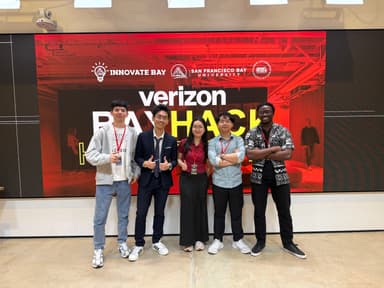
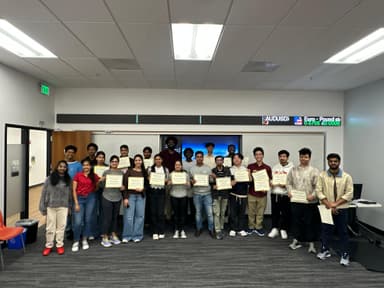
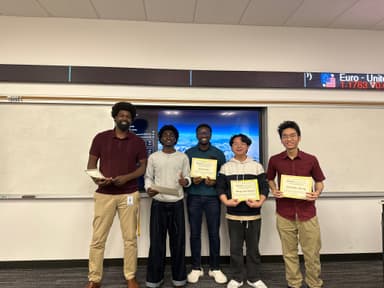
3rd Place — Wildfire detection & response
Innovate Bay (BayHawk 2.0)
- Weekend build at Verizon Innovation Lab context: fused live camera smoke/flame detection (YOLOv8) with NASA FIRMS thermal hotspots and local weather feeds so alerts could be corroborated or dismissed.
- Added LLM reasoning layers to summarize evidence, assign severity (low → critical), and propose concrete response steps instead of raw scores only.
- Backend built with FastAPI, async task orchestration, and PydanticAI agents coordinating specialized prompts.
- Frontend stack: Vite + Tailwind for rapid UI iteration; PostgreSQL for incident logs; Dockerized services for reproducible deploys; CI/CD toward Vercel-hosted assets.
- Demonstrated end-to-end flow from sensor ingestion to operator-facing dashboard within hackathon time constraints.
Hackathon · Multi-agent AI · YOLOv8 · NASA FIRMS · FastAPI · PydanticAI · GPT-4o · Innovate Bay · BayHawk 2.0 · Verizon Innovation Lab · FastAPI · Python · Vite · Tailwind CSS · PostgreSQL · Docker · GitHub · Git · GitHub CI/CD · Vercel
Mar 2026
Hackathon — KryptosProof

HackHayward (Cal State East Bay)
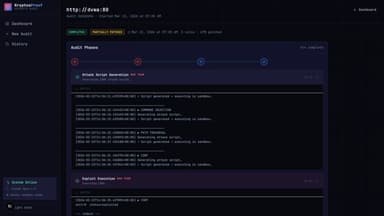
- 24-hour security sprint: multi-agent “red team” that launches real scanners (sqlmap, Nuclei, FFUF), deduplicates noisy output, and focuses on reproducible vulns only.
- Automatic remediation drafts plus verifier passes before writing findings into a SHA-256–signed PDF-style report for authenticity.
- Docker sandbox isolated risky tooling from host machines; live dashboard streamed job progress for judges.
- Lean narrative: fewer buzzwords, more evidence chains suitable for demo to engineers—not slide-only fluff.
Hackathon · Security · Docker · Nuclei · Multi-agent · HackHayward · KryptosProof
Feb 2026
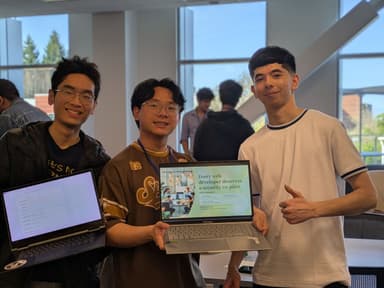
1st Place — Uniflow (ThinkNext 2026 · SFBU IEEE)

ThinkNext 2026
- Career copilot for SFBU students: intake agents capture goals and constraints; critique agents workshop resumes with structured feedback loops.
- RAG stack embedded course catalogs + campus events—chunked, embedded, and retrieved via vector search so answers cite real offerings.
- Mock interview lane combined OpenAI TTS/STT with STAR-style scoring prompts so users rehearse aloud or typed.
- Streamlit shell for fast iteration during judging; modular agents implemented with PydanticAI orchestration patterns.
- Pitch emphasized responsible personalization—clear logging when suggestions touched sensitive academic data.
Hackathon · PydanticAI · RAG · OpenAI · TTS · STT · Streamlit · SFBU · Career
Oct 2025
2nd Place — Bit for Bit (receipts → inventory)
Innovate Bay (BayHawk 1.0)
- BayHack 2025 business-action track: mobile receipt capture → OCR extraction → structured MongoDB records → conversational assistant for reconciling stock counts.
- Designed prompts + retrieval guardrails so SMB owners could query inventory without exposing unrelated receipts.
- Full stack blended Node.js services, Python utilities for OCR glue, FastAPI gateways, and OpenAI APIs for natural-language reconciliation.
- Live pitch + demo with teammates showcasing inventory deltas versus spreadsheet chaos.
- Lessons logged on schema discipline—inventory reconciliation fails quietly when receipt categories drift.
Hackathon · BayHack · OpenAI API · MongoDB · FastAPI · Node.js · Python · OCR · Inventory
Now
Released Tomville 0.2.x on PyPI: a retro terminal office where my AI coding agents (Claude Code, Codex) walk around as pixel pets, with a GitHub Issues task board and a Telegram bot to run the team from my phone.
Started research on robot motion planning with Dr. Satarupa Mukherjee (SFBU School of Engineering): 30,000+ simulated trials on when goal-biased RRT fails; first-author paper in preparation. Wrapped up my founding-member role at Quiche.
Drafting two papers: AI restoration of war photographs (ethics + vignette study) and RRT with a vector maze formulation. Public repos in motion: TTorch (C++/Python autograd), Desir (agentic assistant), a real-time emotion CV stack, and a maze-solving visualizer. Tightening this minimal site to match reality.
Third place at Innovate Bay (BayHawk 2.0) for a wildfire stack: YOLOv8 + NASA FIRMS + weather context, fused with a multi-agent LLM pipeline (PydanticAI, GPT-4o, FastAPI) for severity and response planning.
HackHayward weekend: shipped KryptosProof — multi-agent, tool-using red team (sqlmap / Nuclei / FFUF), Docker sandbox, live dashboard, and signed reports for the vibe-coding security angle.
Contact
Feel free to reach out. I'm always happy to chat about deep learning, open source, or interesting problems.